Guide a dead world through six eras — until its cities light up and its people leave for the next star.
About the game
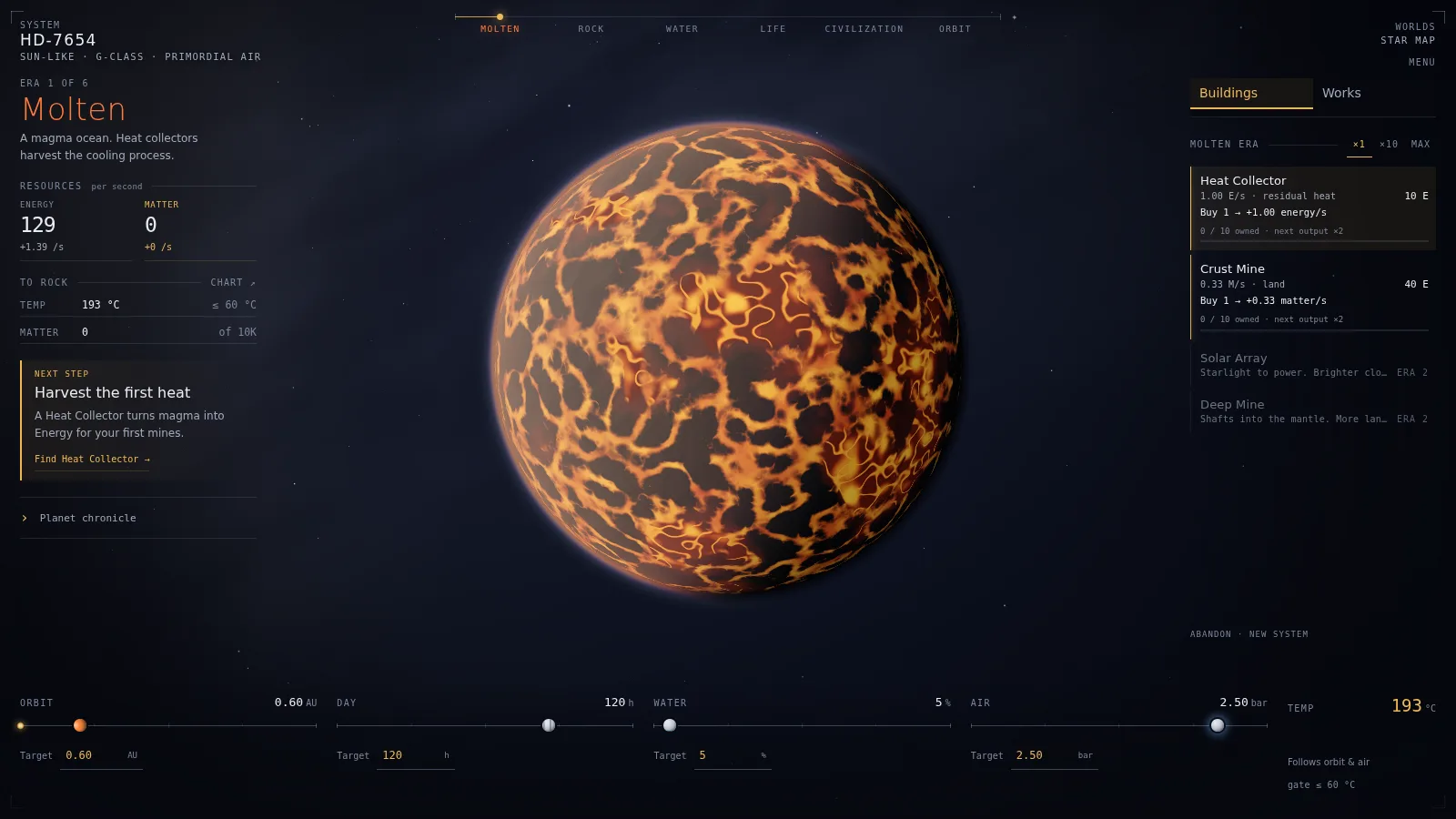
First Light never shows you an era number. It shows you the planet. The crust sets as you harvest the cooling magma; the sea arrives with the comets you capture; the continents green as the biosphere grows; the sprawl widens and the lights brighten with the population. Dial the orbit back into the fire and the world melts again.
Four dials describe the planet physically — orbit radius, rotation period, water fraction, atmospheric pressure. Moving one costs Energy and takes real time. Every era demands a window, and the star type shifts all of them at once: a red dwarf forces you close, where tidal locking looms; a blue-white giant pours out energy through a narrow habitable zone.
Reaching orbit starts the Exodus. Take everyone for maximum Legacy, or leave a colony that beams you Knowledge forever. Then pick the next star from three known bundles — star type, system kind, planet trait — and start again with automation you earned. Every departed world stays on the Star Map as a small rotatable globe with its own chronicle.
What you actually do
- 01
The planet is the UI
Procedural lava, ocean shelves, ice caps, seasons and night-side cities, rendered with Three.js and GLSL. Every building you buy appears on the surface.
- 02
Four physical dials
Orbit, day length, water and air. Real ranges, real consequences, an orbital chart that tells you in plain words what to move.
- 03
Events on the world, not in a popup
Solar storms, comet showers, supervolcanoes, glaciations, a rare supernova. Each has an optional response with a price.
- 04
Works
Two one-off projects per era, strategic opposites. Starting one closes the other on this planet — the game's one irreversible choice.
- 05
Exodus and Legacy
Prestige with a decision. Colonies form a network that finances late systems; the Star Map keeps every world you've left.
- 06
Fully idle
Ten hours of offline progress (twenty-four with Legacy), auto-buy, Era Autopilot, and a one-line save code you can paste anywhere.